
What Codex Goals are, how to switch them on, and ten marketing workflows that fit them better than a prompt does.
Codex has a feature most marketers will probably skip because it looks like a developer thing: Goals. OpenAI describes it as an experimental Codex CLI feature for long-running work with a clear objective and a verifiable stopping condition.
That sounds technical, but the underlying idea is simple. Instead of asking an AI agent for one answer, you give it a bounded piece of work to finish.
Join the waitlist and get notified when the new AdLume is ready. It catches wasted ad spend automatically and optimises campaigns around the clock.
One email, on the day access opens. Nothing else, and you can leave the list with one click.
Example.
Goal: Refresh these 5 SEO articles until each one has updated metadata, stronger internal links, source-backed edits, and a short QA checklist. That shift matters for marketing because most AI work still happens as prompt dumping:
The output arrives quickly. Then the human still has to remember the source files, the brand rules, the goal, the approval gates, the quality bar, the next step, and what "done" means.
That is where things usually break. A draft sits in a folder. A campaign audit turns into a vague list. A customer interview summary loses the exact quote that made it useful. A lead magnet gets 80 percent finished and then quietly dies somewhere between "needs polish" and "I'll do it tomorrow."
Codex Goals are interesting because they push the work into a tighter operating frame. The agent needs a target, sources, constraints, and a stop condition. For marketing teams, solo founders, PPC freelancers, and agencies, that is often the missing layer.
In OpenAI's Codex documentation, Goals are described as a way to give Codex one durable objective for work that can continue across turns until a verifiable end state is reached. OpenAI positions them for long-running coding work: migrations, large refactors, deployment loops, experiments, prototypes, games, and prompt optimization.
The official starter prompt looks like this:
Goal: Complete [objective] without stopping until [verifiable end state]. How to enable Goals in CodexOpenAI marks Goals as experimental, so you need to enable them before using them.
Open Codex CLI and run:
/experimental Then enable Goals from the experimental features menu if it is available in your build.
On a typical local Codex setup, open:
~/.codex/config.toml
Add.
[features]
goals = true
If your config already has a [features] section, add only the goals = true line under it. If it does not, add the full block.
Then start a new Codex session and test that the Goals command is available.
After it is enabled, you can:
A good goal tells Codex:
That is also a good description of serious marketing work.
Codex is still a coding agent. That is its center of gravity. But OpenAI's own Academy material describes Codex more broadly as an agent you can delegate real work to. It can work across files, tools, and repeatable workflows. It can create documents, update files, build dashboards, gather information, and move tasks forward.
That matters because modern marketing is full of file-based workflows.
A founder's marketing system might include:
The bottleneck is rarely "we need more AI output." The bottleneck is usually continuity.
Can the agent read the right sources? Can it keep the task inside scope? Can it avoid inventing claims? Can it produce something reviewable? Can it stop before doing something visible or expensive?
Codex Goals fit that class of work.
A normal prompt is enough when you want a quick answer.
Give me 10 LinkedIn post ideas about Codex Goals. That is useful for brainstorming. A Goal Plan is better when the work has multiple steps and a real finish line.
Example.
The full library of AdLume skills: paid ads, landing pages, B2B leads, GTM tracking, e-commerce.
The bundle goes straight to your inbox, then one email a week. Unsubscribe in one click. We never share your address.
Goal: Create a publish-ready SEO article about Codex Goals for marketers.

Read first:
- the official OpenAI Codex Goals page
- the Codex prompting guide
- the existing blog style guide
- the last 5 published articles

Do not invent product features.
Do not use unsupported claims.
Do not publish anything.

Finish only when the draft has:
- title and meta description
- H1/H2 outline
- full article body
- 10 practical marketing workflows
- source links
- LinkedIn distribution post
- QA notes That gives Codex a working loop. It can gather context, produce the asset, check the rules, and stop with a reviewable package.
Use this as the base:
Goal: Complete [marketing outcome] until [verifiable end state].

Read first:
- [files, docs, exports, customer research]

Audience:
- [ICP or segment]

Scope:
- [what can be changed]

Out of scope:
- [what must stay untouched]

Quality bar:
- [tone, proof, SEO, source rules, compliance rules]

Approval gates:
- Do not publish, send, launch, increase spend, contact people,
  or change live systems without approval.

Verify:
- [checks, screenshots, source sweep, link check, data reconciliation]

Stop when:
- [done condition, blocker, or review point]The approval gate is boring on purpose. In marketing, agents can quickly cross into public-facing or reputation-sensitive work. Posting on LinkedIn, changing a live landing page, sending follow-ups, editing tracking, or increasing ad spend should stay gated.
Codex can prepare the work. You approve the external action.
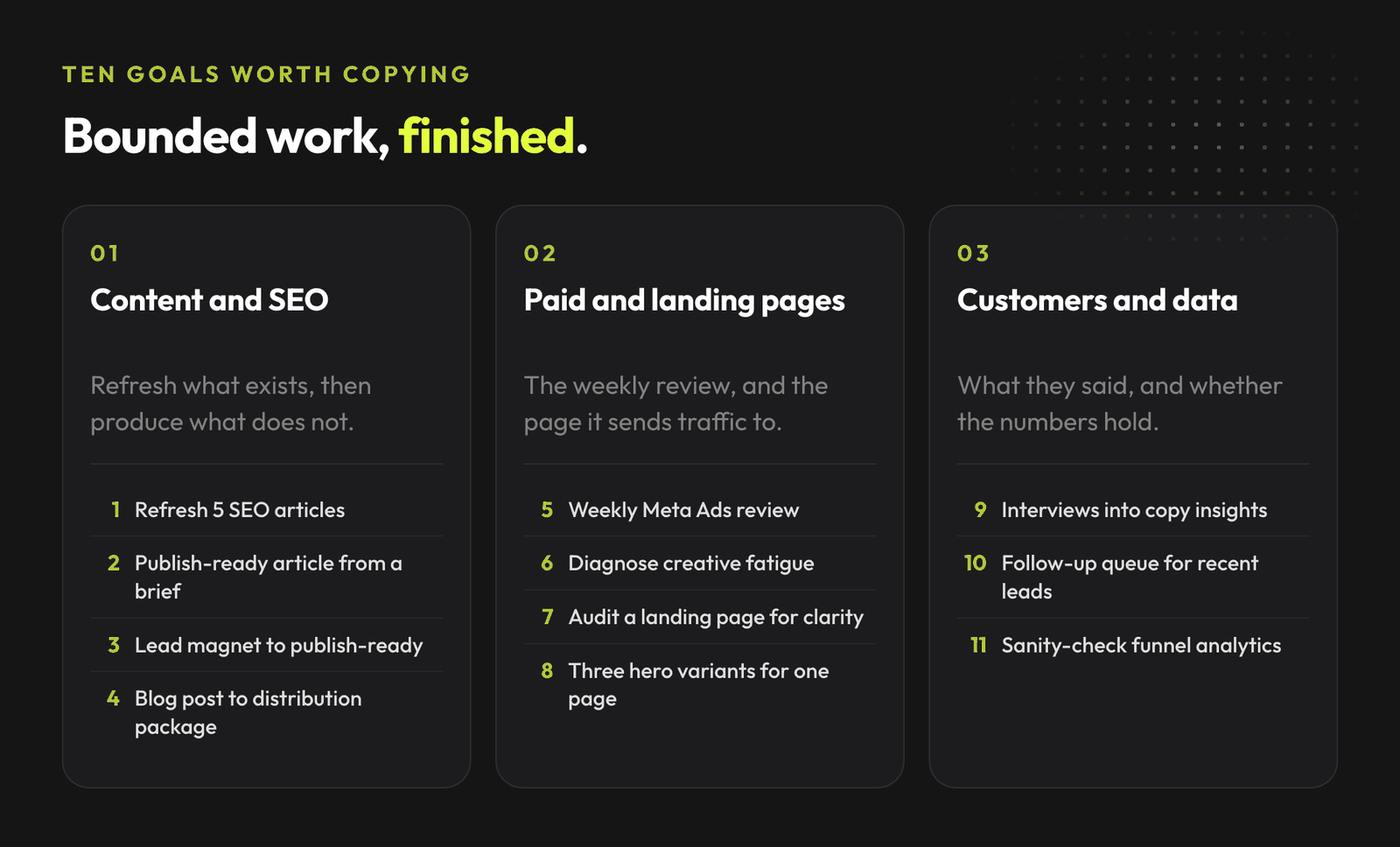
Below are 10 practical Codex Goals workflows you can copy and adapt.
They are written for marketers, founders, PPC operators, freelancers, and agency owners who want AI to finish bounded work instead of generating another pile of ideas.
If your main use case is performance marketing, this is also the operating pattern behind AdLume: turning messy Google Ads work into clearer diagnostics, priorities, and next actions. You can still build your own Codex workflows from the templates below. If you want that kind of loop inside a product instead of maintaining it yourself, keep an eye on the AdLume callouts in this article.
Use this when older articles need updating, internal links, metadata, or source cleanup.
Goal: Refresh 5 SEO articles listed in SEO_REFRESH.md.

Read first:
- each article
- latest GSC export
- target keyword list
- internal linking map
- brand voice rules

Scope:
- title
- meta description
- H2/H3 structure
- outdated sections
- internal links
- FAQ section

Out of scope:
- changing the core thesis without flagging it
- adding unsupported statistics
- publishing to WordPress

Verify:
- every article has a primary keyword
- every added claim has a source
- all internal links point to live URLs
- title and meta fit SEO limits

Stop when:
- each article has a final draft and a short change log.2. Article from briefUse this when you already have a topic, sources, and target keyword.
Goal: Create a publish-ready SEO article from BRIEF.md.

Read first:
- BRIEF.md
- official sources listed in the brief
- ICP notes
- last 5 published blog posts

Scope:
- SEO package
- outline
- full article draft
- FAQ
- source list
- suggested internal links

Out of scope:
- publishing to WordPress
- inventing data
- changing the offer or positioning

Verify:
- focus keyword appears in H1 and opening section
- all external claims are sourced
- article has a direct answer in the intro
- internal links are relevant

Stop when:
- the article can be reviewed in one file.3. Landing page auditUse this when a page exists but the conversion argument is weak.
Goal: Audit the /demo landing page for conversion clarity.

Read first:
- current landing page copy
- screenshot of the page
- ICP file
- top customer objections
- analytics snapshot if available

Scope:
- messaging gaps
- weak proof
- CTA clarity
- objection handling
- hero section rewrite

Out of scope:
- redesigning the whole page
- changing pricing
- pushing changes live

Verify:
- every recommendation maps to a specific section
- every rewrite explains which objection it handles
- risky claims are flagged

Stop when:
- there is a prioritized issue list and 3 hero variants.4. Paid ads reviewUse this when campaign review keeps turning into a messy Slack thread.
Goal: Prepare the weekly Meta Ads review for week 20.

Read first:
- campaign export
- previous checkpoint
- test hypothesis
- budget guardrails
- funnel conversion snapshot

Scope:
- spend
- CTR
- CPC
- CPM
- conversion events
- creative performance
- next decision

Out of scope:
- increasing budget
- launching new ads
- changing audiences

Verify:
- decision is one of: keep, iterate, pause, investigate
- recommendation references the original test hypothesis
- budget changes are placed under approval gates

Stop when:
- the review ends with one recommended next action.5. Creative fatigue triageUse this before asking AI to write new ad angles.
Goal: Diagnose creative fatigue in the lead gen campaign.

Read first:
- creative performance export
- launch dates
- spend by creative
- CTR, CPC, CVR, CPA
- previous creative test notes

Scope:
- fatigue signals
- winners
- weak creatives
- refresh candidates
- variant recommendations

Out of scope:
- writing new ads before diagnosis
- changing campaign settings

Verify:
- every creative gets one status: keep, refresh, retire, test variant
- each status has a short reason
- low data creatives are marked as inconclusive

Stop when:
- the campaign has a creative action queue.6. Interview synthesisUse this when you have transcripts but no usable copy inputs.
Goal: Turn 8 customer interview transcripts into copy insights.

Read first:
- all interview transcripts
- ICP notes
- current landing page copy

Scope:
- pains
- objections
- desired outcomes
- exact customer language
- moments of tension

Out of scope:
- inventing insights
- overgeneralizing from one quote
- writing final landing page copy

Verify:
- every insight includes interview ID
- important claims include a short quote
- themes are grouped by frequency and intensity

Stop when:
- there is a map: pain -> quote -> copy implication -> page section.7. Lead magnet polishUse this when the asset exists but still feels like a draft.
Goal: Bring CODEX_GOALS.md to publish-ready quality.

Read first:
- current lead magnet draft
- ICP notes
- lead magnet quality rules
- similar published resources

Scope:
- title
- promise
- structure
- examples
- instructions
- CTA
- QA checklist

Out of scope:
- creating a different lead magnet format
- changing the target audience
- publishing the page

Verify:
- the asset gives the reader a concrete ability
- examples are copy-paste usable
- CTA is clear
- no unsupported claims were added

Stop when:
- the lead magnet has a final draft and publishing checklist.8. Asset repurposingUse this after publishing a strong article, report, or lead magnet.
Goal: Turn BLOG.md into a distribution package.

Read first:
- BLOG.md
- brand voice rules
- published post index
- newsletter format

Scope:
- LinkedIn post
- newsletter section
- 5 short snippets
- first comment copy
- internal distribution checklist

Out of scope:
- duplicating posts from the last 60 days
- writing a generic summary
- publishing or scheduling

Verify:
- LinkedIn post has its own angle
- newsletter section reads native to email
- snippets do not overpromise the asset

Stop when:
- all distribution assets are ready for review.9. CRM follow-up queueUse this carefully. Let Codex prepare the queue, not send messages.
Goal: Prepare a follow-up queue for leads from the last 14 days.

Read first:
- CRM export
- meeting notes
- previous email threads
- lead qualification rules

Scope:
- lead status
- suggested next step
- draft follow-up
- reason for follow-up

Out of scope:
- sending emails
- changing deal stage
- making custom offers

Verify:
- every draft references actual context
- no message invents urgency
- unclear leads are marked for manual review

Stop when:
- each lead has a status and reviewable draft.10. Tracking cleanupUse this when your reporting is full of events nobody trusts.
Goal: Sanity-check analytics events for the trial funnel.

Read first:
- current event schema
- PostHog or GA4 export
- funnel documentation
- product onboarding notes

Scope:
- inconsistent names
- duplicate events
- missing events
- events that do not map to decisions
- suggested event schema v2

Out of scope:
- changing tracking code
- editing production GTM
- declaring tracking broken without evidence

Verify:
- every issue includes evidence
- suggested schema maps events to business decisions
- changes requiring live edits are separated under approval gates

Stop when:
- there is a table of issues, fixes, and approval-gated changes. When Goals are the wrong toolDo not use Goals for tiny tasks.
If you need one headline, one email subject line, or a quick list of ideas, a normal prompt is faster.
Goals are useful when the work has:
Weak goal.
Goal: Improve our marketing. Better goal:
Goal: Create 3 hero section variants for /demo.

Read first:
- ICP notes
- customer objections
- current landing page copy

Do not change the rest of the page.

Finish when:
- each variant has a headline, subheadline, CTA, and a note explaining which objection it handles. Codex performs better when it knows the boundary. The same is true for people, to be fair.
AI made output cheap. Control stayed expensive.
It is easy to generate 20 posts, 10 ad angles, or a landing page rewrite. It is harder to make sure the work reads the right source files, uses real customer language, respects approval gates, avoids fake claims, fits the channel, and actually reaches a reviewable end state.
Codex Goals do not remove judgment. They move more of the operating contract into the task itself. That is the interesting part.
You can tell the agent:
For solo founders and small marketing teams, that is a better pattern than building a folder full of half-used prompts.
The future of AI-assisted marketing probably looks less like prompt collecting and more like small, bounded operating loops: SEO refresh, paid ads review, lead magnet polish, customer research synthesis.
The value shows up when pieces of work finally make it from "idea" to "reviewable output" without dying in the middle. That is where Codex Goals get interesting.
AdLume watches your ad accounts and brings the next fix to your team's tools.
One email, on the day access opens. Nothing else, and you can leave the list with one click.
OpenAI documents Codex Goals as an experimental Codex CLI feature. They are designed for long-running work with a durable objective and a verifiable stopping condition.
The official examples are mainly technical, such as migrations, refactors, prototypes, and prompt optimization. The same operating pattern can be adapted to marketing when the work has sources, scope, approval gates, and a reviewable end state.
A prompt usually asks for one answer. A Goal Plan defines the outcome, source material, constraints, approval gates, verification method, and stopping condition.
Only if you give it tools and permission. For marketing work, it is safer to add approval gates. Codex can prepare drafts, audits, queues, and recommendations. Publishing, sending, launching, spend changes, and live tracking edits should require human approval.
Good first candidates include SEO refreshes, landing page audits, weekly paid ads reviews, creative fatigue diagnosis, customer interview synthesis, lead magnet polish, CRM follow-up queues, and analytics cleanup.
A way to give Codex one durable objective for work that can continue across turns until a verifiable end state is reached, rather than a single prompt and answer.
Goals are experimental. Enable them from the Codex CLI experimental features menu, or add a [features] block with goals = true to ~/.codex/config.toml, then start a new session.
A normal prompt is enough for a quick answer or brainstorm. A Goal Plan is better when the work has multiple steps, real sources and a defined finish line.
Join the waitlist and get notified when the new AdLume is ready. It catches wasted ad spend automatically and optimises campaigns around the clock.
One email, on the day access opens. Nothing else, and you can leave the list with one click.