
Thirty free skills for B2B lead generation, split between the leads that come to you and the week you go out and find them.
Most B2B lead gen fixes start in the wrong place.
Someone sees cost per lead go up and immediately rewrites ads. Or swaps audiences. Or changes bidding.
Join the waitlist and get notified when the new AdLume is ready. It catches wasted ad spend automatically and optimises campaigns around the clock.
One email, on the day access opens. Nothing else, and you can leave the list with one click.
But the real problem is often downstream:
B2B lead generation is a system. Ads, landing pages, CRM, sales notes, call recordings and follow-up all have to point in the same direction.
So I built a pack for the whole system: 30 Claude Skills for B2B lead generation. Free. Open source. Built for teams that care about lead quality, sales feedback and pipeline. Get all 30 B2B lead gen skills on GitHub ->
A Claude Skill is a self-contained workflow.
It has YAML frontmatter that tells Claude when to activate, and a Markdown body that defines the job: required inputs, analysis workflow, output format, decision rules, and guardrails.
That matters in B2B lead gen because generic prompting breaks fast.
You need the agent to know what to read, what to ignore, what is missing, what counts as evidence, and when a human has to approve the next step.
The skills in this repo are designed to work with exports, screenshots, CRM data and sales notes today. If you have live connectors later, you can adapt the same workflows to pull live data. The first version does not require write access, campaign mutation, or any promise that AI will manage ads for you.
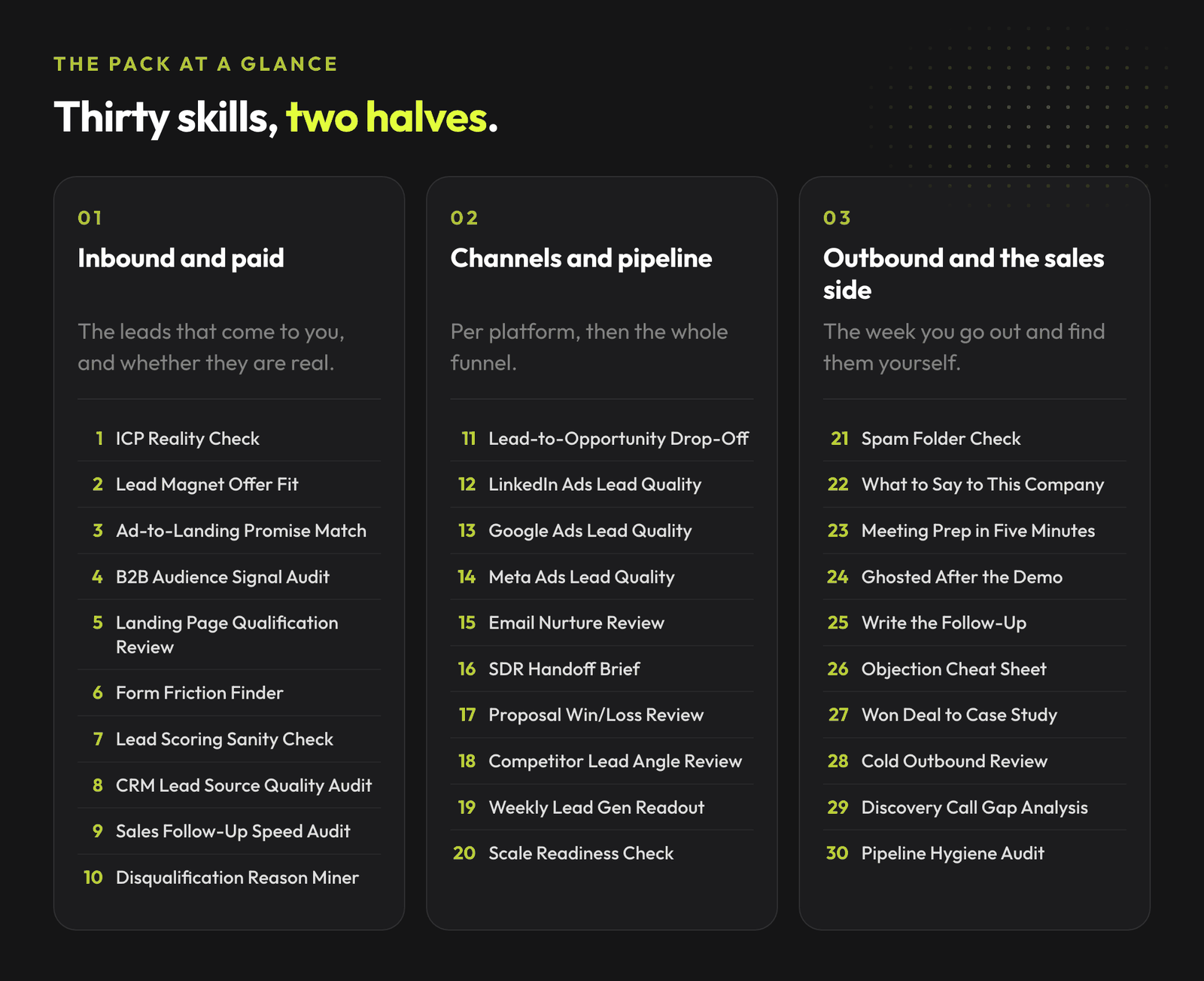
The first twenty assume a lead already arrived: someone clicked, filled a form and appeared in the CRM. They ask whether the right leads are arriving.
# | Skill | What it does |
|---|---|---|
1 | ICP Reality Check | Compares your stated ICP against actual closed-won and closed-lost customers. |
2 | Lead Magnet Offer Fit | Checks if your free asset matches the buyer stage and real pain. |
3 | Ad-to-Landing Promise Match | Verifies that ads, landing page and CTA promise the same thing. |
4 | B2B Audience Signal Audit | Reviews targeting signals for job titles, industries, intent and exclusions. |
5 | Landing Page Qualification Review | Diagnoses whether the page attracts the right leads or just more leads. |
6 | Form Friction Finder | Finds fields, steps and UX patterns that kill form completion. |
7 | Lead Scoring Sanity Check | Tests scoring rules against real CRM outcomes and sales feedback. |
8 | CRM Lead Source Quality Audit | Ranks lead sources by downstream stage, value and close rate. |
9 | Sales Follow-Up Speed Audit | Measures response time impact on qualification and conversion. |
10 | Disqualification Reason Miner | Extracts why sales rejects leads and maps it back to targeting or creative. |
11 | Lead-to-Opportunity Drop-Off Review | Finds where qualified leads stall before becoming pipeline. |
12 | LinkedIn Ads Lead Quality Audit | Diagnoses LinkedIn campaign quality using CRM feedback and cost per qualified lead. |
13 | Google Ads Lead Quality Audit | Separates search intent quality from keyword bloat and match-type leaks. |
14 | Meta Ads Lead Quality Audit | Reviews Meta lead forms and ads for qualification strength and signal fit. |
15 | Email Nurture Sequence Review | Checks follow-up emails for relevance, timing and call-to-action clarity. |
16 | SDR Handoff Brief Generator | Produces context for sales: source, intent signals, likely objections, next question. |
17 | Proposal Win/Loss Review | Learns from won and lost deals to fix upstream targeting and messaging. |
18 | Competitor Lead Angle Review | Reverse-engineers competitor angles you are losing to. |
19 | Weekly B2B Lead Gen Readout | Summarizes facts, hypotheses, next actions and approvals for the week. |
20 | Scale Readiness Check for Lead Gen | Decides if you should add budget or fix qualification and follow-up first. |
The second ten are about the week when nothing arrives. Going out to accounts yourself, getting the email delivered, walking into the call, and dealing with what happens after it.
# | Skill | What it does |
|---|---|---|
21 | Spam Folder Check | Checks whether your cold emails reach inboxes at all, from SPF, DKIM, DMARC and sending posture |
22 | What to Say to This Company | Turns one target account into one specific opening angle, or says honestly that there is none |
23 | Meeting Prep in Five Minutes | One page before a call: who they are, what to ask, what would disqualify them |
24 | Ghosted After the Demo | Works out why a good call went silent, and writes the message that might restart it |
25 | Write the Follow-Up | The next email, built around new information rather than checking in |
26 | Objection Cheat Sheet | One page of objections and answers, built from your own lost deals |
27 | Won Deal to Case Study | Turns a closed-won deal into a draft case study plus the permission email |
28 | Cold Outbound Sequence Review | Says which of list, opener, ask or cadence is killing the sequence |
29 | Discovery Call Gap Analysis | Reads a transcript and finds the question that was never asked |
30 | Pipeline Hygiene Audit | Separates defensible pipeline from decoration before the forecast conversation |
Read that list and notice what is not on it. No dashboards, no attribution models, no scoring frameworks. That is deliberate, because it is not what the week actually looks like.
The week looks like a call in twenty minutes with a company nobody has researched, a deal that went brilliantly and then went silent, an email rewritten four times, and a pipeline number that is about to be presented and only half believed.
Each skill is data-first.
They expect exports, reports, screenshots, URLs, CRM notes, sales notes, call notes, disqualification reasons and weekly summaries. If the data is missing, the skill says so.
That is the point.
B2B lead gen gets risky when AI sounds confident while the evidence is thin.
Clone the repo and copy the skill folders into your project's .claude/skills/ directory, or into ~/.claude/skills/ for user-level access.
Get all 30 B2B lead generation skills on GitHub ->
git clone https://github.com/mardab96/b2b-lead-generation-claude-skills.git
mkdir -p ~/.claude/skills
cp -r b2b-lead-generation-claude-skills/*-* \
      b2b-lead-generation-claude-skills/scripts \
      b2b-lead-generation-claude-skills/references \
      ~/.claude/skills/
Start a new Claude Code session. The skills activate automatically when their description matches what you are asking for.
Each skill is plain Markdown with YAML frontmatter. Paste the relevant SKILL.md file into context when you want to use it.
You describe the problem in normal language.
"We get cheap LinkedIn leads but sales says they are junior."
Claude can route to LinkedIn Ads Lead Quality Audit and Disqualification Reason Miner. It asks for platform lead volume, CRM stages, sales notes and disqualification reasons.
"Form fills are up but demos are down."
Form Friction Finder and Landing Page Qualification Review activate. They check form fields, page copy and qualification strength.
"Can we scale budget next month?"
Scale Readiness Check for Lead Gen activates. It reviews conversion quality, follow-up speed, creative capacity, landing page capacity and sales capacity.
The skills work best with actual exports.
The full library of AdLume skills: paid ads, landing pages, B2B leads, GTM tracking, e-commerce.
The bundle goes straight to your inbox, then one email a week. Unsubscribe in one click. We never share your address.
Recommended inputs.
If you only have screenshots, start with screenshots. The output will have lower confidence and a missing data section.
B2B lead gen is a money and time system.
A small upstream change can move budget toward worse leads, teach the platform the wrong signal, waste sales time or make a founder think the wrong channel is working.
So the workflow should look like this:
That workflow is slower than pretending the agent is an autopilot.
It is also much easier to trust.
There is no single feedback-loop skill in this pack. The loop runs across several of the twenty: the LinkedIn, Google Ads or Meta Ads Lead Quality Audit on the platform side, then CRM Lead Source Quality Audit and Disqualification Reason Miner on what sales actually saw. Together they ask for two sides of the story:
Then it checks whether the issue is likely:
The output turns "lead quality is bad" into a decision path.
Scaling is usually where messy lead gen systems get exposed.
The Scale Readiness Check skill looks at:
Then it returns one of four verdicts:
The useful part is the rollback plan.
If budget goes up and cost per qualified lead rises by a defined threshold, the skill tells you what to watch and when to undo the change.
Spam Folder Check goes first in any outbound conversation, and almost nobody runs it first. A delivery problem and a copy problem look identical from the outside: replies stop. So everyone rewrites the subject line. If the SPF record has eleven DNS lookups it fails entirely and receivers treat the domain as having no SPF at all, and no amount of better writing survives that.
Ghosted After the Demo exists because the standard explanation is that the prospect got busy. That is comfortable, occasionally true, and rarely the whole story. Usually the person on the call could not approve the purchase, or nobody said a number out loud, and both were audible at the time. The skill reads the thread and the call notes and says which, then writes a message that fits the diagnosis instead of another note that says just checking in.
Two skills ship a Python helper. Pipeline Hygiene Audit uses one to age deals, measure inactivity and separate defensible pipeline from decoration. Spam Folder Check uses one to parse SPF, DKIM and DMARC, including the lookup limit and the policy qualifier, which are short strings with a lot of load-bearing punctuation.
The scripts exist because a language model counting stale deals across a few hundred rows produces a number that feels right and is not, and a forecast built on that number is worse than no forecast. Everything else in the pack reads text and produces text, where a script would be ceremony rather than rigour.
The skills do not.
They are built for diagnosis and approval-ready recommendations.
If your B2B lead gen workflow already runs through a senior operator, these skills make recurring checks easier to repeat.
If your workflow is a mess of prompts, screenshots and Slack threads, this gives you a cleaner starting point.
Three practical ways to use the repo:
If you also run broader paid ads, you may want the companion pack:
The broader shift is simple: B2B lead gen is becoming a set of repeatable AI-assisted workflows.
The teams that win will keep the messy human parts visible: business context, signal quality, tradeoffs, approvals, and the reason behind each change.
AdLume watches your ad accounts and brings the next fix to your team's tools.
One email, on the day access opens. Nothing else, and you can leave the list with one click.
A Claude Skill is a self-contained workflow: YAML frontmatter tells Claude when to activate, and a Markdown body defines the job, the required data, and the output format.
No. They do not change budgets, pause campaigns, publish ads, edit tracking setup, change conversion events or modify landing pages. They are built for diagnosis and approval-ready recommendations.
Campaign exports from LinkedIn, Google Ads and Meta, landing page URLs or screenshots, form setups, and CRM or sales notes. If you only have screenshots, start there: the output will have lower confidence and a missing-data list.
Clone the GitHub repo and copy the skill folders into your project's .claude/skills/ directory or into ~/.claude/skills/. In other Claude environments, paste the relevant SKILL.md file into context.
Start where your evidence already points. If sales says the leads are junior or off-ICP, run the Lead Quality Audit for that channel and then Disqualification Reason Miner. If form fills are up but demos are not, run Form Friction Finder and Landing Page Qualification Review. If you are deciding whether to add budget, run Scale Readiness Check for Lead Gen. If you cannot name the problem yet, run ICP Reality Check against your closed-won and closed-lost list first.
No. The pack reads data you already have: campaign exports, CRM stages, form analytics, sales notes and disqualification reasons. It does not source contacts, enrich records or scrape prospect lists. The closest thing is CRM Lead Source Quality Audit, which ranks the sources you already run by what happened downstream.
The paid ads pack stops at the ad account: wasted spend, creative fatigue, bidding, campaign structure. This one follows the lead after the click, through the form, the CRM, the follow-up and the sales verdict. Three skills overlap on purpose, the LinkedIn, Google Ads and Meta Ads lead quality audits, because that is where the two systems meet. Run both if you buy B2B leads and also own what happens to them.
Ten of the thirty are sales skills rather than top of funnel, numbered 21 to 30: Spam Folder Check, What to Say to This Company, Meeting Prep in Five Minutes, Ghosted After the Demo, Write the Follow-Up, Objection Cheat Sheet, Won Deal to Case Study, Cold Outbound Sequence Review, Discovery Call Gap Analysis and Pipeline Hygiene Audit. Three more sit in the first twenty: Sales Follow-Up Speed Audit, Disqualification Reason Miner and Proposal Win/Loss Review. Most of that second ten need nothing exported, so you paste an email thread, a call transcript or a company name.
Join the waitlist and get notified when the new AdLume is ready. It catches wasted ad spend automatically and optimises campaigns around the clock.
One email, on the day access opens. Nothing else, and you can leave the list with one click.