
Fifteen free skills for the part of the job that starts after the draft exists.
AI gets you a first draft in thirty seconds. Then the work starts.
You still have to check the angle, fix the CTA, add the proof, cut the filler, answer the objection and decide whether it is good enough to publish. That is where most AI-assisted marketing work dies, and it does not die at the blank page. It dies in the gap between "there is a draft" and "this is finished".
Join the waitlist and get notified when the new AdLume is ready. It catches wasted ad spend automatically and optimises campaigns around the clock.
One email, on the day access opens. Nothing else, and you can leave the list with one click.
Call it the last twenty percent, which is a figure of speech rather than a measurement, because nobody has measured it and this post is not going to pretend otherwise.
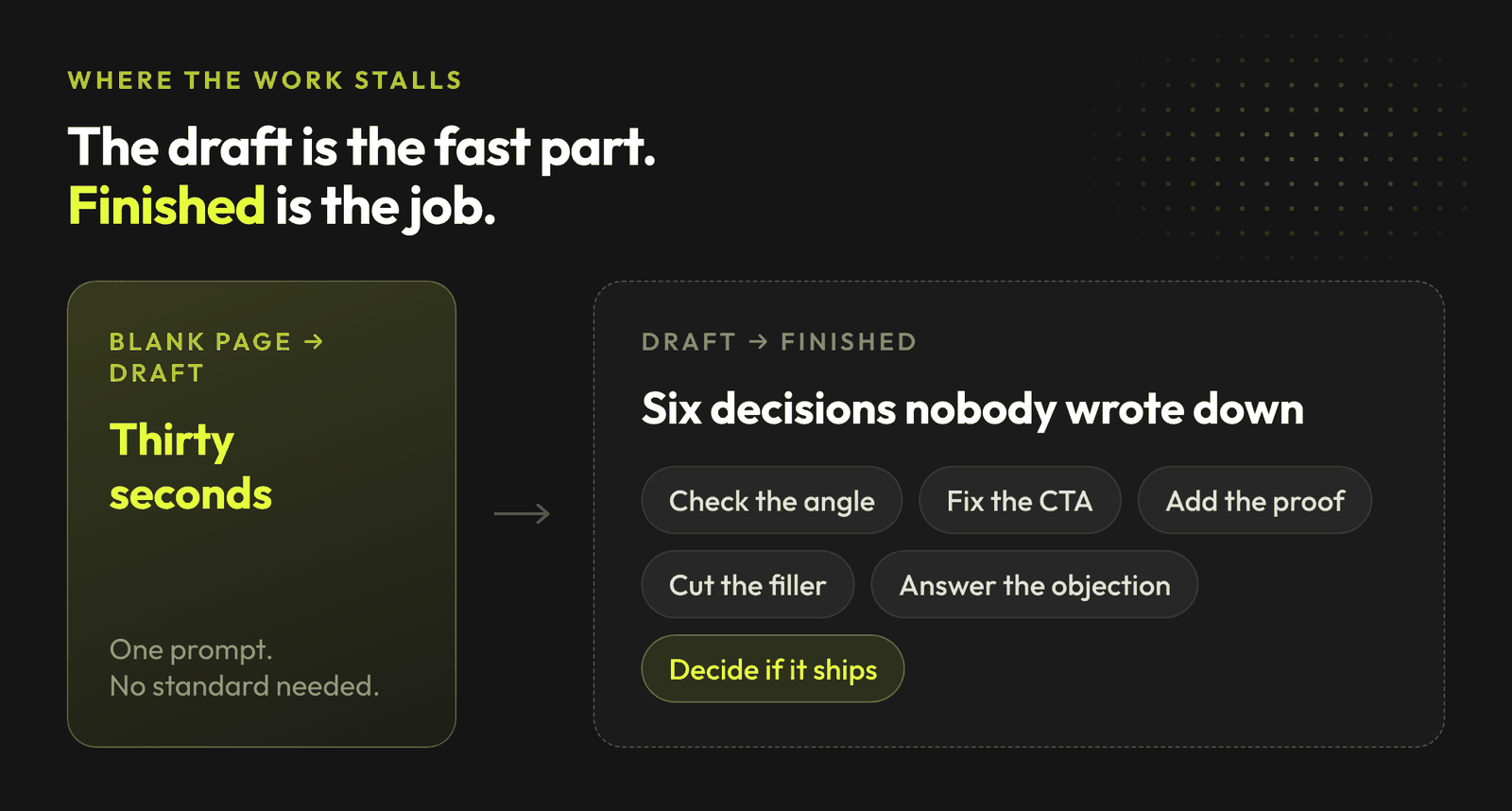
I built fifteen Claude Skills for that gap. They are free, MIT licensed, and they work on the drafts already sitting in your folder.
Because it never says what finished means.
A broad instruction gets you a broad answer. The model produces something plausible, you read it, something is off, you ask again, and the second version is different rather than better. Nothing in the exchange defines the standard, so nothing can be checked against it.
Weak, because nothing ends it:
Improve this landing page.
Strong, because a stranger can tell when it is finished:
Keep revising until the hero states one outcome, every claim on the page
has a source or a visible gap marker, the CTA matches the offer, and the
remaining issues are ones only the owner can decide.
The second one is not a longer prompt. It is a different kind of instruction: it carries a definition of done.
That definition is what makes another pass possible. Without one, a revision has nothing to aim at.
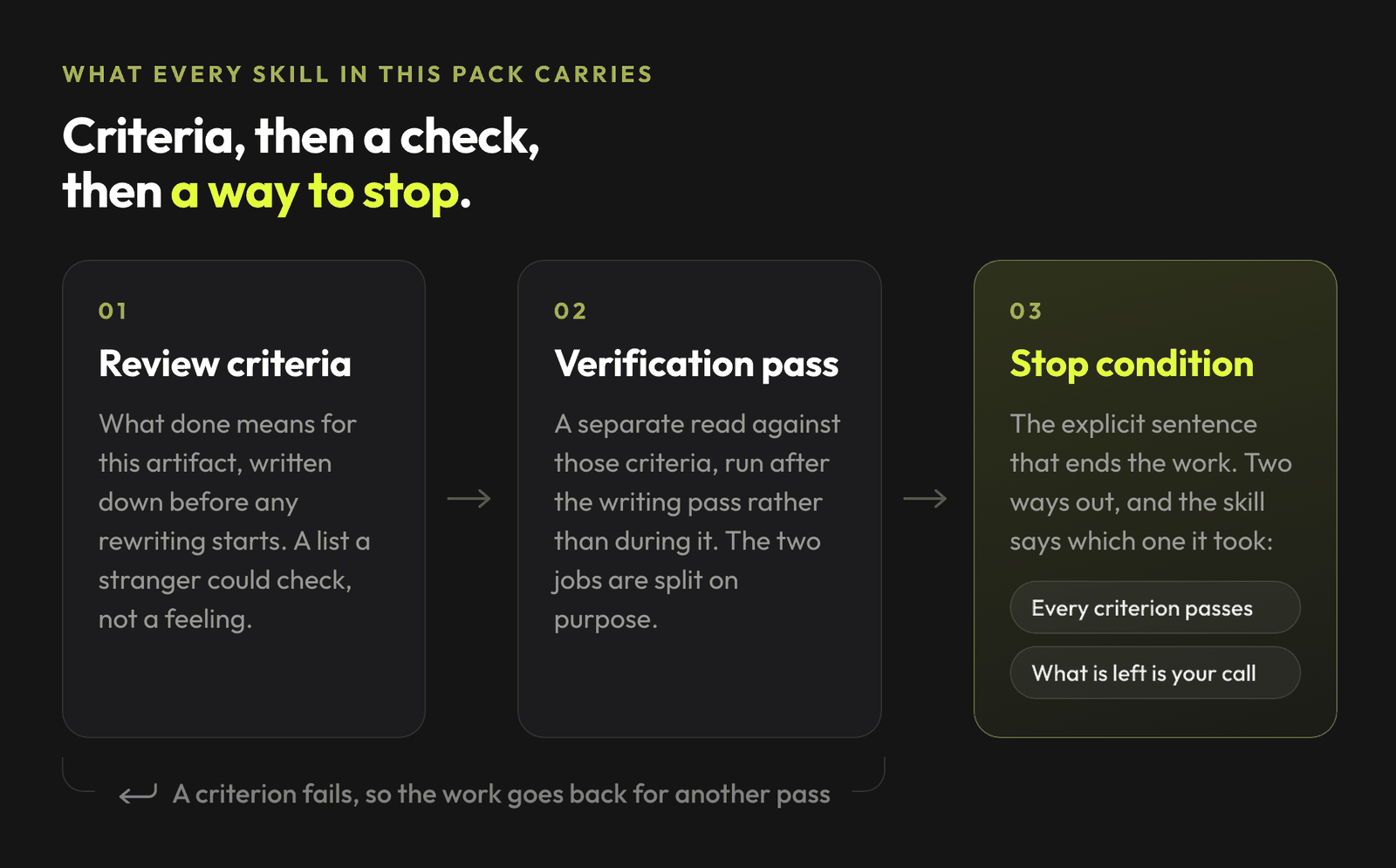
Review criteria. What done means for this artifact, written down before any rewriting starts. A list a stranger could check, not a feeling. The criteria come from the skill, not from you, because encoding that judgment is most of the value.
A verification pass. A separate read against those criteria, run after the writing pass rather than during it. The model is worse at checking work while it is still attached to producing it, so the two jobs are split on purpose.
A stop condition. The explicit sentence that ends the work. Either every criterion passes, or the remaining gap needs a human decision, and the skill says which. Without this you get one pass. With it you get work that keeps going until it meets a standard you set.
The full library of AdLume skills: paid ads, landing pages, B2B leads, GTM tracking, e-commerce.
The bundle goes straight to your inbox, then one email a week. Unsubscribe in one click. We never share your address.
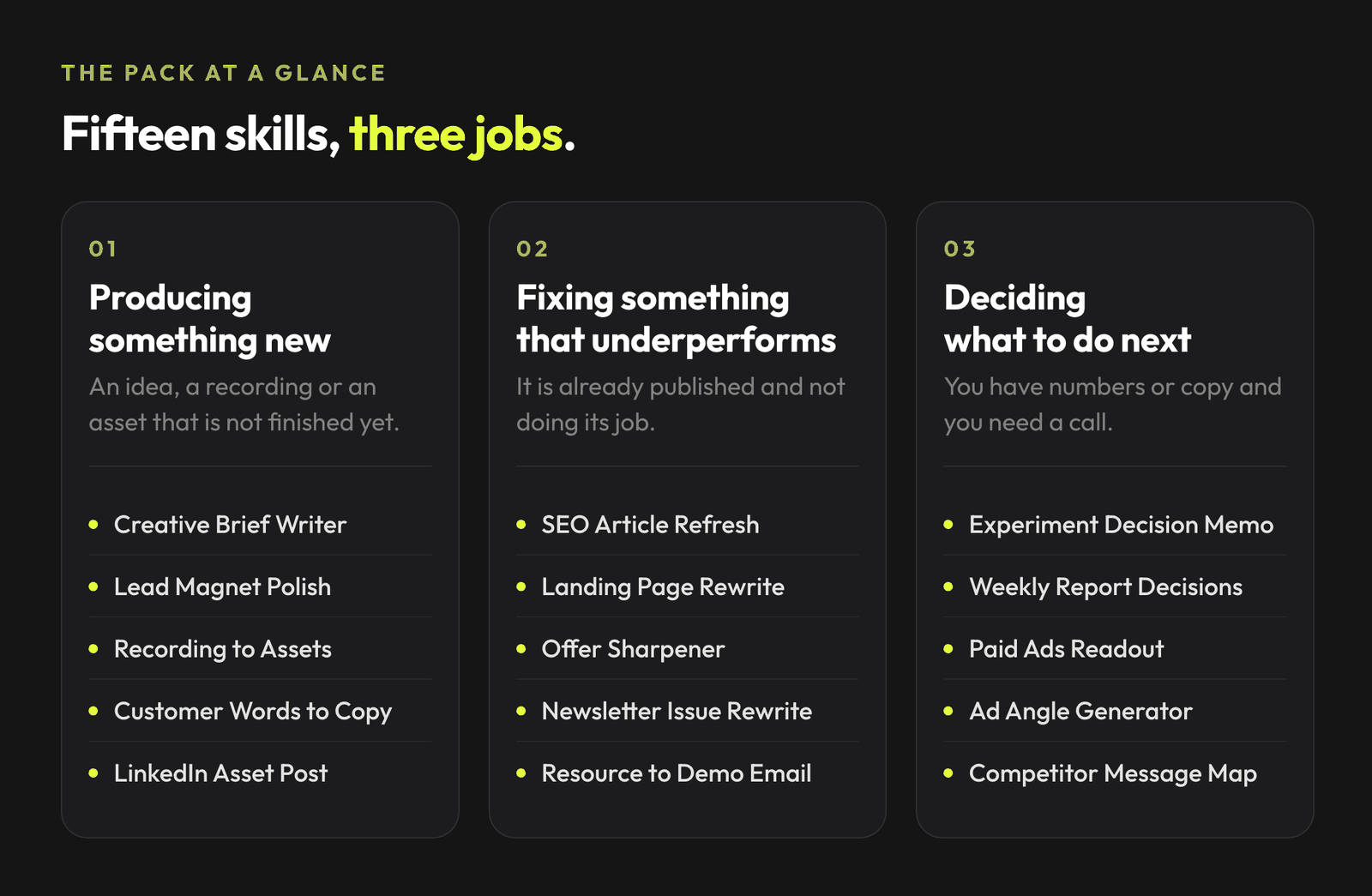
Three jobs, five skills each. Every one of them starts from something you already have: a draft, a URL, a recording, or numbers you paste in.
Get all 15 marketing workflow skills on GitHub ->
git clone https://github.com/mardab96/marketing-workflows-claude-skills.git
mkdir -p ~/.claude/skills
cp -r marketing-workflows-claude-skills/*-* ~/.claude/skills/
Start a new Claude Code session. The skills usually activate on their own when what you are doing matches, and you can always name one directly.
Each folder is self-contained. Nothing inside a skill points at another file in the repo, so copying one folder works exactly as well as copying all fifteen.
Two habits change the output more than anything else.
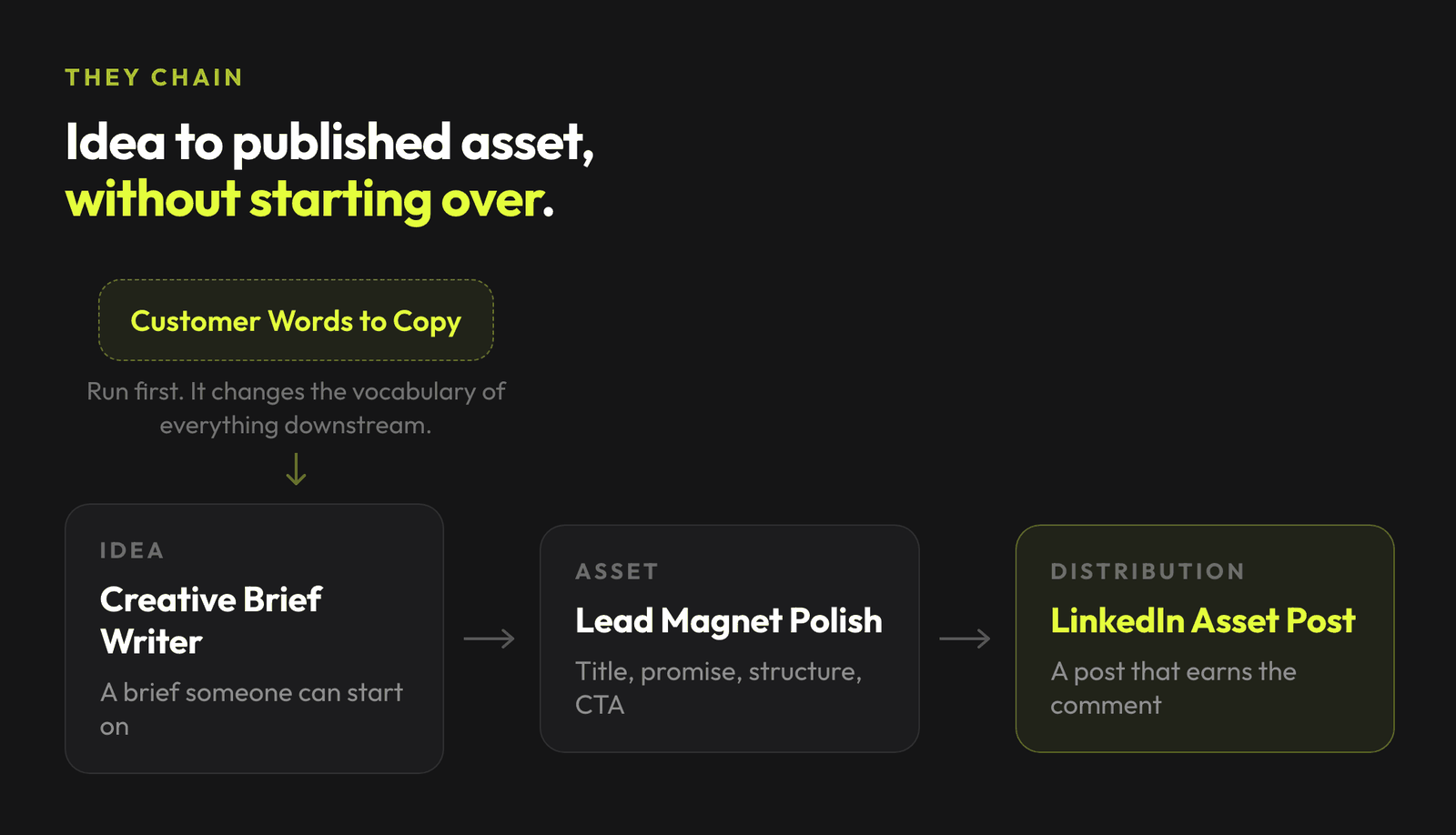
They also chain. A brief into a lead magnet into a LinkedIn post is the whole path from idea to published asset. Customer language before any writing skill changes the vocabulary of everything downstream.
They do not publish, send, post or spend anything. They do not log into your accounts, because none of them have access to one and all of them work from what you paste.
They do not invent statistics, quotes or results your inputs do not support. Where a claim cannot be verified it gets marked rather than smoothed over, which is occasionally annoying and always the right behaviour.
Everything that leaves your machine is your decision, made after you have read the draft.
AdLume watches your ad accounts and brings the next fix to your team's tools.
One email, on the day access opens. Nothing else, and you can leave the list with one click.
For Claude Code, yes, you need a plan that includes it. The skills themselves are free and cost nothing to use, but they run inside Claude, and Claude's own pricing applies. If you do not have Claude Code, the files are plain Markdown and you can paste any one of them into a conversation and it works the same way.
No. None of them have account access and none of them execute anything. They produce drafts, diagnoses and decisions for you to act on.
Yes. Each folder is self-contained and nothing inside a skill references another file in the repo.
A prompt gives you one pass. These carry the criteria a result is checked against and the condition that ends the work, so a second and third pass have something to aim at.
MIT licensed. Fork them, rewrite the criteria to match your standards, ship them inside your own work.
Join the waitlist and get notified when the new AdLume is ready. It catches wasted ad spend automatically and optimises campaigns around the clock.
One email, on the day access opens. Nothing else, and you can leave the list with one click.