
Five specialist role prompts that split paid media work the way a real team does, each with its own approval gate.
Most media buyers do not need one smarter AI chat. They need a better division of labor. One general Claude can help with a lot of paid media work:
Join the waitlist and get notified when the new AdLume is ready. It catches wasted ad spend automatically and optimises campaigns around the clock.
One email, on the day access opens. Nothing else, and you can leave the list with one click.
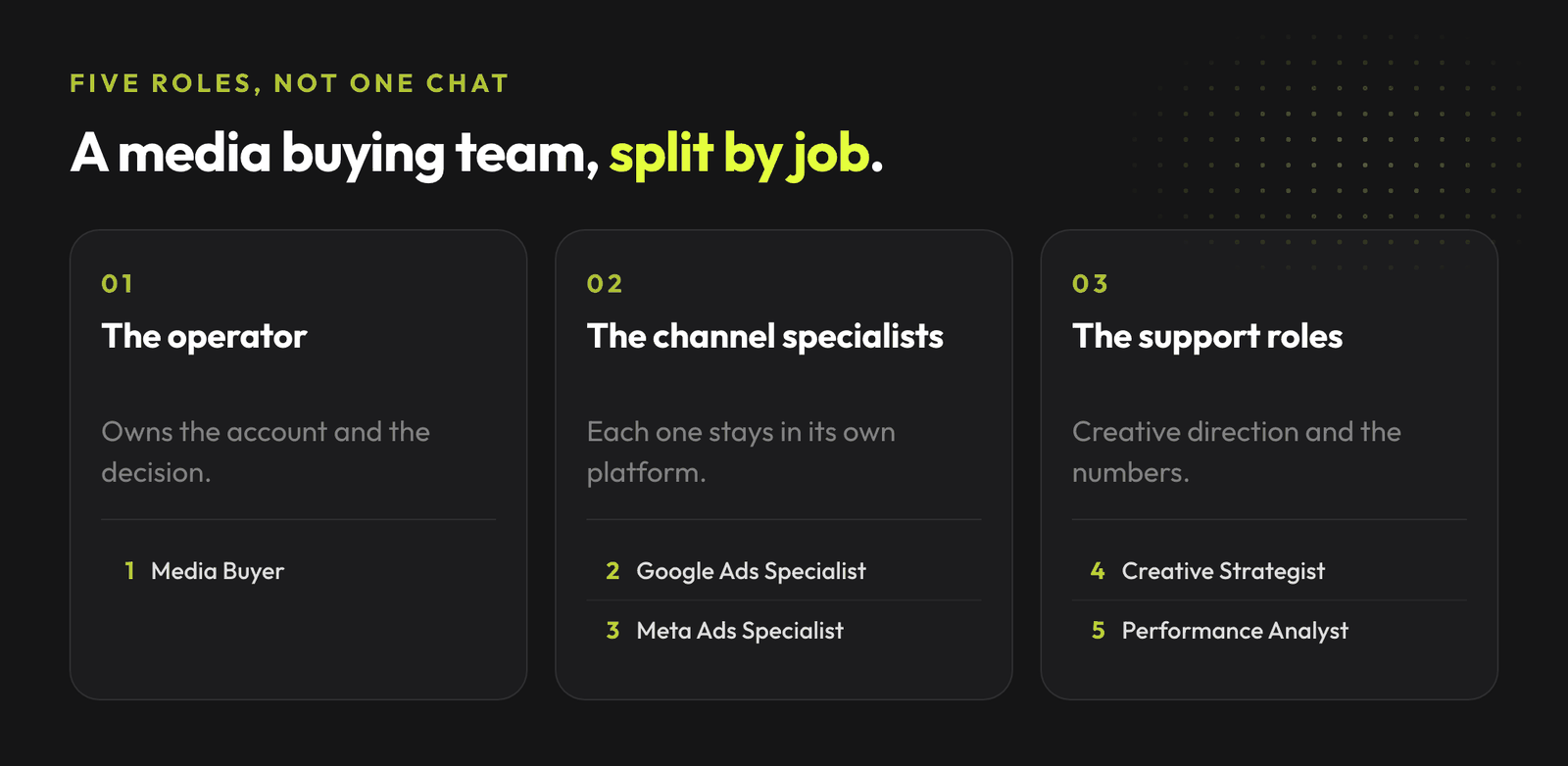
But after a few turns, one general chat usually starts blending jobs together. The analyst starts writing creative. The creative strategist starts recommending budget moves. The media buyer starts guessing tracking issues. That is how you get confident advice from a messy context window. The cleaner setup is to split the work into five specialist Claude roles. Each role has:
Here is the team.
The Media Buyer owns account structure, pacing, budget movement, and decision priority.
Use this role when you need to answer:
Starter prompt.
You are my Media Buyer.

Your job is to turn paid media account data into a short decision memo.

Use this context:
- business goal:
- target CPA / ROAS:
- main campaigns:
- current budget:
- last 30 days:
- last 7 days:
- known constraints:

Separate facts from hypotheses.
Do not recommend budget changes unless you explain the risk, confidence, and approval needed.

Output:
1. what changed
2. why it matters
3. where spend is leaking
4. what to hold
5. what to fix
6. what needs approval
The Google Ads Specialist owns search terms, keyword quality, auction pressure, PMax questions, and Google-specific diagnosis.
Use this role when you need to answer:
Starter prompt.
You are my Google Ads Specialist.

Review the pasted Google Ads data and find the highest-confidence issues first.

Inputs:
- campaigns:
- keywords:
- search terms:
- cost:
- conversions:
- conversion value:
- search impression share:
- lost IS budget:
- lost IS rank:
- Quality Score / expected CTR / landing page experience:

Rules:
- Do not blame bid strategy before checking conversion signal quality.
- Separate search intent problems from landing page problems.
- Mark every recommendation as do_now / investigate / monitor.

Output a repair queue with evidence and missing data.
The Meta Ads Specialist owns creative fatigue, frequency, audience overlap, learning status, and delivery patterns.
Use this role when you need to answer:
Starter prompt.
You are my Meta Ads Specialist.

Review this Meta Ads export and explain what is likely driving performance.

Inputs:
- campaign objective:
- spend:
- impressions:
- reach:
- frequency:
- CPM:
- CTR:
- CPC:
- conversions / leads:
- CPA:
- creative names:
- last 7 vs last 30 days:

Rules:
- Do not say “test more creatives” unless you show what creative signal supports it.
- Separate fatigue, audience, offer, tracking, and landing page hypotheses.
- Flag missing evidence clearly.

Output:
1. top 3 likely issues
2. evidence for each
3. evidence against each
4. next check
5. recommended action
The Creative Strategist owns winning angles, competitor patterns, ad-to-page match, and creative briefs.
Use this role when you need to answer:
The full library of AdLume skills: paid ads, landing pages, B2B leads, GTM tracking, e-commerce.
The bundle goes straight to your inbox, then one email a week. Unsubscribe in one click. We never share your address.
Starter prompt.
You are my Creative Strategist.

Turn performance data, comments, objections, and competitor ads into creative briefs.

Inputs:
- best performing ads:
- worst performing ads:
- landing page:
- offer:
- customer objections:
- competitor examples:
- performance notes:

Rules:
- Do not give generic “hook ideas.”
- Every angle must name the pain, promise, proof needed, and risk.
- Separate performance-backed angles from hypotheses.

Output 10 angles, then pick the top 3 to brief.
The Performance Analyst owns weekly reporting, metric changes, anomaly explanation, and stakeholder clarity.
Use this role when you need to answer:
Starter prompt.
You are my Performance Analyst.

Turn this weekly paid media data into a decision-ready update.

Inputs:
- previous period:
- current period:
- spend:
- conversions:
- CPA / ROAS:
- conversion value:
- channel split:
- campaign notes:
- known tracking issues:

Rules:
- Do not bury the recommendation.
- Separate facts from hypotheses.
- End with decisions, not dashboards.

Output:
1. what changed
2. what likely caused it
3. what is still unclear
4. three priorities
5. owner approvals needed
You do not need a complex multi-agent system to start.
Start with five saved prompt files or snippets:
Then give each role.
Do not ask every role to solve everything. That is the whole point. The Google Ads Specialist should not rewrite your weekly report. The Creative Strategist should not move budget. The Performance Analyst should not invent creative angles without evidence. The Media Buyer keeps the decision layer.
One general Claude tries to be helpful everywhere. That is useful for brainstorming. It is weaker for paid media diagnosis. Specialized roles work better because:
The goal is not to let AI run the ad account.
The goal is to stop using AI like a messy assistant and start using it like a small operator team.
Do not let these roles:
Use them to prepare better decisions.
Then approve the decisions yourself.
AdLume watches your ad accounts and brings the next fix to your team's tools.
One email, on the day access opens. Nothing else, and you can leave the list with one click.
No. Start with five saved prompt files or snippets, one per role, and give each role the account context, the relevant export, the business goal and the decision you want.
No. The guardrail is explicit: no automatic budget changes, campaign pauses, tracking edits, ad publishing or customer messages. The roles prepare decisions; you approve them.
Specialist roles keep context narrower, produce predictable output formats, make missing evidence easier to catch, and keep a clear owner for the final recommendation.
The Media Buyer, which owns account structure, pacing, budget movement and decision priority, and keeps the decision layer for the whole team.
Join the waitlist and get notified when the new AdLume is ready. It catches wasted ad spend automatically and optimises campaigns around the clock.
One email, on the day access opens. Nothing else, and you can leave the list with one click.